Facebook Community
 Change Log
 Help Center


- Understand SEO A/B Testing
- Differences Between CRO vs. SEO Split Testing
- Advantages of SEO A/B Testing
- What Can You Test With SEO Split Tests?
- 5 Best SEO A/B Testing Tools for Shopify Stores
- How To Set Up And Run A Shopify SEO A/B Test
- Common Pitfalls to Avoid For SEO A/B Testing
- A/B Testing SEO Tips And Tricks on Shopify
- Conclusion
- FAQs about SEO A/B Testing

 Shopify
SEO A/B Testing for Shopify: Definition, What To Test, Best Tools, How To Set Up, Mistakes To Avoid & Expert Tips
Shopify
SEO A/B Testing for Shopify: Definition, What To Test, Best Tools, How To Set Up, Mistakes To Avoid & Expert Tips
SEO A/B Testing for Shopify: Definition, What To Test, Best Tools, How To Set Up, Mistakes To Avoid & Expert Tips

Search engine optimisation (SEO) is one of the most crucial aspects for Shopify stores, but many still treat it as a matter of guesswork. They try to update a title tag, add new content, tweak meta descriptions, or change images, and simply wait to see what happens. This causes unexpected things: Was the traffic drop caused by a competitor's update or a Google update?
This is where SEO A/B testing can help you handle everything to achieve the best performance!
Compared to making assumptions or relying on outdated best practices, A/B testing gives you a controlled, data-driven method to validate which changes actually drive organic traffic. This blog will clarify what SEO A/B testing is, why it differs from CRO tests, which elements can impact rankings, the SEO A/B testing tools that should be considered, and expert guides on setups.
Let’s begin now!
Understand SEO A/B Testing
What Is SEO Testing?
SEO testing is the process of changing on-page or structural site elements and measuring their impact on organic search performance. Unlike CRO tests, which focus on clicks or purchases, these tests measure indicators such as impressions, ranking positions, and organic clicks.

Key indicators should be focused on SEO AB testing
There are several methods for testing SEO changes, such as time-based tests, controlled experiments, and multivariate tests; however, SEO A/B testing is highly recommended by many experts. It operates by isolating one variable and comparing two groups of similar webpages:
- Group A (Control): unchanged
- Group B (Variant): modified with the SEO change
In this way, your SEO testing is split into 2 groups, making it referred to as SEO split testing. Search engines index both groups at the same time, letting you attribute performance changes to the variation itself, not seasonal fluctuations, algorithm updates, or time-based randomness.
However, not every site can run SEO testing effectively. To achieve reliable results, you should satisfy two conditions: a large set of pages built on the same templates and a consistent level of organic traffic. Stores with hundreds of similar URLs, such as travel websites, e-commerce catalogs, real estate listings, or job directories, are often ideal candidates for this approach. This doesn’t mean that you cannot run SEO A/B testing on a small Shopify store, but you will need to rely on larger and more noticeable changes to detect meaningful differences.

Differences Between CRO vs. SEO Split Testing
|
CRO A/B Testing |
SEO A/B Testing |
|
• Evaluates user interactions (e.g., clicks, scrolls, and purchases). • Traffic is routed 50/50 between variants. • Results appear quickly (days). • Measure conversion metrics. • Use JavaScript or page editors. |
• Evaluate search engine behaviours (rankings, impressions, and clicks) • No traffic split; search engines index each page version separately. • Results are available after weeks due to indexing cycles. • Measure search visibility metrics. • Use on-page modifications and structured data changes. |
Advantages of SEO A/B Testing
1. Ability to Prove Causation, not Only Correlation
The first advantage of SEO A/B testing is its ability to isolate causal impact. Traditional time-based tests, or simply rolling out changes and “watching what happens,” cannot reliably distinguish whether performance shifts result from your optimization or from external forces. By comparing a variant group to a control group of highly similar pages, SEO testing creates a statistically valid environment where you can identify which on-page changes impact rankings.
2. Stronger Scientific Reliability compared to Time-Based Experiments
Time-based testing has its place in an SEO program, but it is vulnerable to shifts in market trends and unpredictable algorithmic fluctuations. Shopify A/B testing, on the other hand, reduces noise by evaluating the performance of many pages under identical external conditions.
With properly selected page clusters and robust statistical modeling, SEO A/B testing yields results that are significantly more trustworthy. Marketing teams can act on outcomes with confidence because effects are measured in relation to a constant, unaffected control group.
3. Ideal for Large Template-Based Websites
Large sites built on consistent templates empowered by Shopify or a Shopify page builder gain the most value from SEO testing. As mentioned above, eCommerce catalogs, travel listings, real estate directories, and marketplace listings contain numerous URLs that are structured in a similar manner. This uniformity makes controlled experiments easier to execute and interpret.

GemPages Page Builder can offer consistent templates for effective SEO testing
Testing can also be conducted on various page types, including product detail pages, collection/ category pages, blog article templates, location/ directory pages, and documentation templates. These environments enable even subtle changes (e.g., adjusting titles, rewriting introductory paragraphs, or modifying schema markup) to be tested at scale with high statistical confidence.
4. Ability to Validate Changes before Full Rollout
SEO recommendations often involve subjective decisions or “best practices” that may not be universally applicable. Implementing changes site-wide without testing can introduce significant risk, especially on high-value or revenue-critical pages. SEO A/B testing allows your teams to:
- Validate hypotheses before committing development resources
- Avoid rolling out changes that reduce organic traffic
- Prioritize initiatives with proven positive impact
- Protect business KPIs while innovating safely
Learn more: Shopify SEO Checklist for Beginners (2025)
What Can You Test With SEO Split Tests?
The benefit of SEO A/B testing is its versatility. You can experiment with almost any on-page or template-level element that influences how search engines crawl, understand, or rank your content. Whether you manage a large content library or focus on SEO for eCommerce websites, using proper split tests can help validate changes with data instead of relying on assumptions.
Below are practical test categories you can get inspired by when brainstorming A/B testing ideas, along with insights on how each change may impact the performance of your projects.
#1. Title Tags and Meta Descriptions
Testing title tags and meta descriptions is one of the simplest and most impactful uses of SEO testing. These elements directly influence how users perceive your page in the SERP, leading to improved CTR. Adjusting keyword placement, adding value propositions, or experimenting with emotional language can reveal which variations attract more clicks. If your goal is to increase conversion rates through A/B testing, optimizing metadata is known as the easiest starting point.
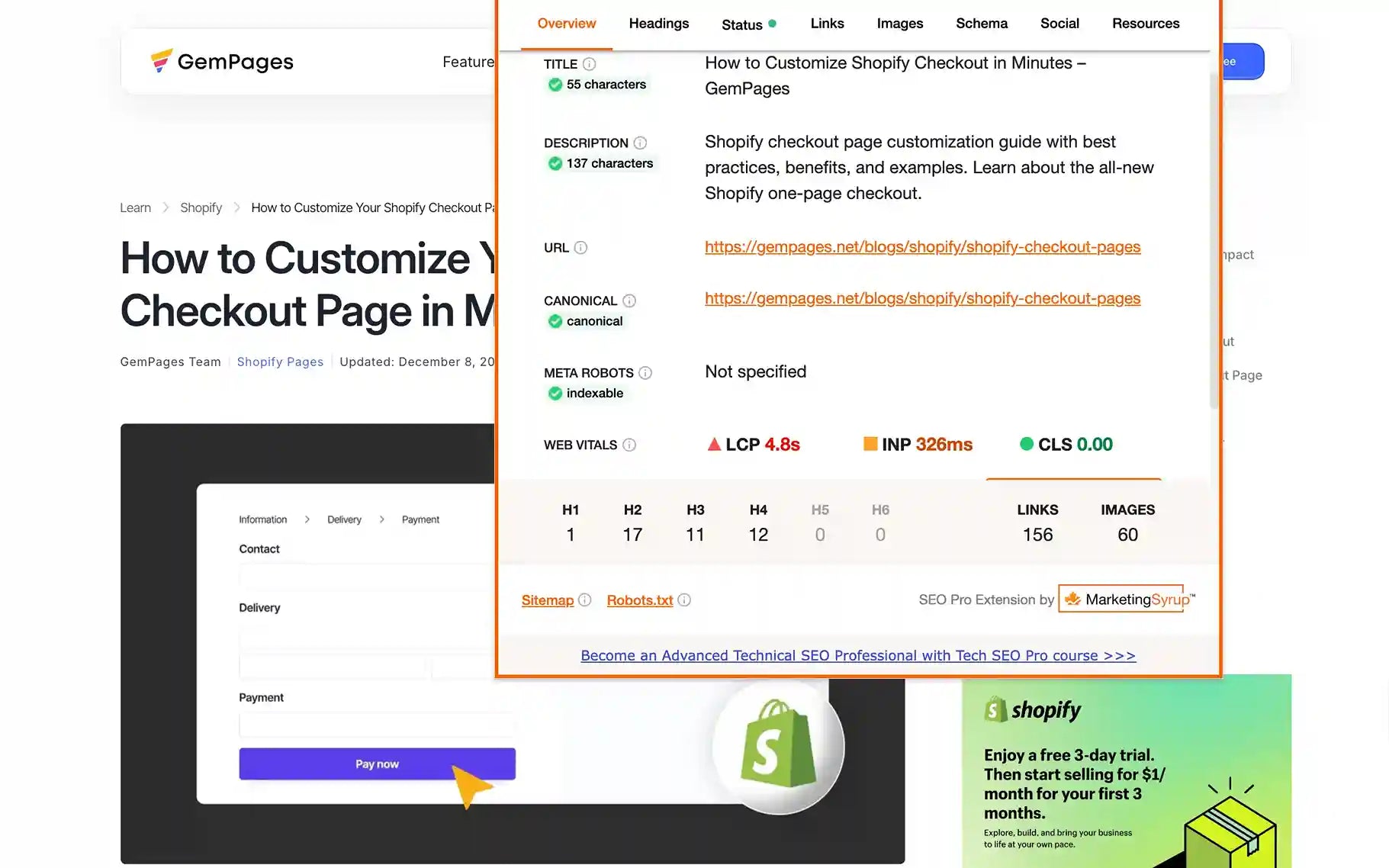
Caption: Title and Meta Description are often the easiest points for SEO A/B testing
#2. Content Length and Format
Content improvements are also significant for split tests. You can conclude whether adding long-form sections, FAQs, updated statistics, visuals, or reordered subheadings increases organic visibility. Many websites experience measurable gains after testing content expansions, especially when the added information enhances depth or more clearly satisfies search intent.
In short, this perspective of SEO A/B testing is particularly useful during content refresh cycles, where improving topical coverage can boost both impressions and clicks from potential visitors.
#3. Page Speed and Core Web Vitals
Website performance optimizations (e.g., compressing images, reducing script execution time, or implementing lazy loading) affect rankings and engagement. Faster pages typically minimize bounce rates and boost time on site, which are positive behavioral signals. Furthermore, running controlled tests allows marketers to validate whether these Shopify page loading speed improvements translate into higher organic traffic or conversions, providing a clear view of ROI.

An example of an excellent Core Web Vitals assessment
Learn more: Important Website Optimization Factors for Seasonal Sales
#4. Structured data
Structured data helps search engines interpret your pages more accurately, unlocking rich results in the SERP. While the direct influence on rankings is not the same for all projects, numerous tests have shown an increase in clicks or impressions following schema optimization. In other words, SEO Split testing ensures that these enhancements are worth deploying across your entire site, especially with complex schemas, like product, recipe, FAQ, or review markup.
#5. H1s, Subheadings, and On-Page Hierachy
Headings help search engines, such as Google and Bing, understand your content hierarchy and enable users to skim through content effectively. Even subtle adjustments, such as refining H1 phrasing, introducing keyword variations, or reorganizing the H2-H3 structure, help search engines more confidently match your content to relevant queries. When tested in a controlled context, website heading optimization typically results in measurable increases in organic clicks.
#6. Product Listing and Display Pages
Product listing pages (PLPs) are among the highest-value pages because they target broad commercial intent queries, especially in eCommerce stores. Testing template variations, such as modifying filters, adding descriptive text, improving pagination, or adjusting product count thresholds, can reveal significant opportunities to grow organic traffic. With SEO A/B testing, you can isolate high-impact changes and roll them out across entire product categories if necessary.

Caption: Gymshark features a well-performing product listing page (PLP)
Product display pages (PDPs) are a part of SEO and conversion optimization techniques. They impact rankings, user engagement, and purchase decisions. Testing elements like product descriptions, schema markup, image placements, and trust badges can help you understand what drives both search visibility and buyer intent. Tools that combine Google Search Console and analytics data allow you to measure organic uplift and conversion changes simultaneously.
Learn more: How to Create A Product List with Product List Element
5 Best SEO A/B Testing Tools for Shopify Stores
#1. GemX: CRO & A/B Testing
- Pricing: $49 to $99/month, 14-day free trial available
GemX: CRO & A/B Testing is a powerful Shopify A/B testing app designed to eliminate guesswork by enabling sellers to run intelligent experiments that effectively improve their website's rankings. It facilitates A/B testing on various aspects of your store, including individual pages, templates, and even multi-page funnels, all with the goal of driving revenue growth.

Gem X: CRO & A/B Testing is an all-in-one SEO A/B testing app for Shopify stores
Additionally, by finding the optimal layout, copy, and Call-to-Action (CTA), Gem X helps boost key SEO performance indicators, such as CTR and Time-On-Page. From that, search engines use this data to assess page quality and relevance, thereby ranking your Shopify site higher. If you are new to SEO A/B testing, learning how to run A/B testing with Gem X will assist you a lot.
Notably, it can work well with GemPages Shopify Landing Page Builder, where you can get 200+ templates for your Shopify website design. Pages built with GemPages are SEO-friendly by design, offering features such as mobile-ready code, speed optimization, and easy access to improve on-page SEO elements, including H1 or H2 tags, image alt text, and meta descriptions. This combination creates an ideal environment for SEO-conscious A/B testing by marketers.
Outstanding features:
-
Create SEO variants at the page or section level
-
Support diverse test types, such as template testing, multipage testing, URL testing, etc.
-
Native integration with GemPages (perfect for landing page tests)
-
Detailed performance metrics (CTR, impressions, ranking movement)
-
Advanced experiment scheduling and rollouts.

#2. Shogun - AB Testing
- Pricing: $0 to $499/month
Shogun is a powerful, free landing page builder tool, but its A/B testing module enables sellers to test page-level changes that may impact organic visibility. It also stands out with its server-side routing, designed to prevent a "flash of content" (FOUC), ensuring a consistent UX. 
Shogun is designed initially as a Shopify page builder, with extensive A/B testing
Outstanding features:
- Support SEO A/B testing for pages, templates, themes, and split URL tests
- Use server-side routing to deliver the correct content instantly
- Include the price testing to maximize profit (available on higher tiers).
#3. Intelligems: A/B Testing
- Pricing: $49 to $999/month
Intelligems is a robust A/B testing platform that specializes in helping eCommerce merchants validate decisions that impact CRO rather than SEO. It goes beyond standard page-content testing to focus on critical financial levers, such as pricing, discounts, and shipping rates. It can provide profit-focused analytics so you can stop guessing and start growing based on data.
Intelligems can do both A/B testing for CRO and SEO, but excels more in CRO
Outstanding features:
- Have profit-centric testing via prices, discounts, offers, thresholds, and shipping rates
- Offer flexible testing scope for themes, content, templates, landing pages, etc.
- Enables precise audience segmentation for targeted strategies.
#4. Shoplift - Split & A/B Testing
- Pricing: $99 to $999/month
The next name in our list of top-rated SEO A/B testing apps for Shopify today is Shoplift. You can run tests directly within the Shopify Theme Editor, making it intuitive and accessible without requiring coding. The app also emphasizes flicker-free testing and provides advanced analytics. 
Caption: Shoplift stands with its unique “Lift Assist” function for split-test automation
Outstanding features:
- Offer “Lift Assist” that can auto-create high-impact split tests based on available sessions
- Easy variant creation and editing directly within the native Shopify Theme Editor
- Enable advanced analytics for RPV, AOV, CVR, and CTR through Bayesian analysis.
#5. AB Convert: A/B Testing
- Pricing: $79 to $249/month
While AB Convert works for product price optimization, shipping rules, and the checkout flow, the SEO split testing appears to be limited to certain aspects. However, if you run tests without a large variety of pages on your website for SEO, AB Convert is still an ideal option to consider. This app also engages marketers with a user-friendly setup that has minimal impact on speed. 
Caption: ABConvert can offer real-time SEO A/B tests across small-to-medium-sized stores
Outstanding features:
- Test varied product prices and experiment with free shipping thresholds and flat rates
- Allow testing the final stage of the customer journey
- Ensures real-time split test results with a light-weight integration for low-speed impact.
How To Set Up And Run A Shopify SEO A/B Test
Step 1: Install A Proper A/B Testing App
Shopify does not natively support SEO split testing. Therefore, your first step is choosing a reliable app capable of isolating traffic, tracking performance, and recording A/B test variations.
In the Shopify App Store, search for “SEO A/B testing” and click the Install to add it.

Search SEO A/B testing on the search engine in the Shopify App Store
After that, you will be navigated to the Shopify Admin Dashboard for your A/B testing projects.
Step 2: Select The Page To Test
You need to decide whether you’re testing a product page, a collection page, a blog post, or another page. Shopify sites often see the most substantial gains from testing collection pages, as they target broader, category-level keywords and receive more consistent organic traffic.
However, product pages, blog templates, and even location pages can all produce excellent testing opportunities. That’s why it’s essential to choose a web page type with sufficient impressions and traffic to ensure the resulting data is robust enough for in-depth interpretation.
Step 3: Formulate A Hypothesis
Your hypothesis defines the goal and direction of your experiment. Instead of testing changes at random, articulate a prediction, such as: “Adding an FAQ section will increase organic clicks by improving content depth,” or “Rewriting the H1 to emphasize the primary keyword will boost CTR for category-level queries".
A precise hypothesis can clarify which metrics matter, either CTR, impressions, or ranking position, and help determine how long your A/B test should run. Typically, an SEO testing project requires a 4- to 8-week period, based on the volume of traffic.
Step 4: Define Your Control and Test Groups
Next, let’s identify which web pages will receive the change and which will remain untouched. For Shopify stores with extensive catalogs, it is recommended to group similar product or collection pages that are built on the same template. The control group represents your baseline performance, while the test group reflects the effect of your change. Additionally, ensure that both groups have comparable traffic levels, keyword intent, and even structural characteristics.
If your catalog is smaller, you may opt to test individual high-impact pages instead of groups. While these tests are practical, they might require stronger variation to yield measurable results.
Step 5: Apply The Change To Your SEO Test Page
Once your groups are defined, you will apply the update only to the test pages. Keep in mind that consistency is critical, making all edits at once to avoid staggered data that could distort the results.
Shopify editor, bulk editing tools, or page builders (e.g., GemPages) can assist this step, especially when testing structural adjustments, such as template redesigns or content blocks. Smaller stores might take minutes, while enterprise Shopify catalogs may require several hours.
Step 6: Measure Performance and Analyze The Outcome
This step requires collecting performance data. Your focus is on organic clicks, impressions, CTR, and, when relevant, conversion metrics. Tools that automatically sync with Google Search Console make this step significantly easier, especially when testing hundreds of web pages.
Once the data stabilizes, it’s time to compare the trend line of the test group against that of the control group. A clear upward shift in clicks, impressions, or CTR indicates a successful test. If performance declines, your changes may harm rankings, and additional investigation is needed.
Learn more: 10+ Winning Tips to Improve Customer Experience for Your Online Store
Step 7: Repeat, Roll Out The Change, or Rollback
Once you review SEO A/B testing, you can choose one of the three following paths to move:
- Roll out the change if the test group consistently outperforms the control group. After that, you can apply the winning variation across all relevant website pages or templates.
- Repeat the test if the initial results are inconclusive. Fluctuations in search demand, low traffic, or external factors, like algorithm updates, can distort the results of a single run.
- Roll back if the results show a negative impact on your Shopify performance. Reverting the change prevents wider damage and allows you to explore alternative strategies.
Pro Tip: For high-volume Shopify stores, it is highly recommended to run a second validation test before rolling out sitewide changes, as this is an innovative risk-management approach.
Common Pitfalls to Avoid For SEO A/B Testing
Now that you have clarified, “What is A/B testing in digital marketing?”, the best tools to perform it on Shopify, and how to run it effectively, it’s equally important to recognize the pitfalls that can compromise your results. SEO testing can be compelling, but only if it is designed and executed correctly. Below are common issues marketers encounter, along with tips on how to avoid them.
- Testing pages with inconsistent search intent
Grouping pages with different keyword types, search intents, or traffic patterns often yields distorted results. Therefore, you need to ensure your test and control groups share the same template, ranking behavior, and purpose.
- Running tests on low-traffic pages
Tests without sufficient impressions or clicks cannot reach significance. If your Shopify pages receive minimal organic traffic, either increase the scope of your test group or choose a more substantial variation that produces noticeable movement.
- Making multiple changes at once
If you tweak titles, metadata, and on-page content simultaneously, you can’t attribute results. Thus, keep your variations isolated unless you are deliberately testing a full-template overhaul.
- Running tests for too short a duration
SEO fluctuations occur naturally due to crawling cycles, seasonality, and competitor activity. Ending a test early based on a temporary spike can lead to false conclusions. That’s why many marketers and experts conduct SEO A/B testing to complete a full cycle, lasting 4 to 8 weeks.
A/B Testing SEO Tips And Tricks on Shopify
The final part we want to discuss is the expert techniques to maximize the return from your SEO split tests on your Shopify site. These tactics help optimize visibility and improve eCommerce UX while maintaining consistent management over your organic performance over the time.
1. Test Search-Impacting Elements Above the Fold First
Elements above the fold, such as your H1, initial product summary, hero copy, and metadata, tend to influence both rankings and CTR. Therefore, Shopify marketers often see the fastest wins by testing H1 phrasing, introductory product descriptions, collection page subheadings, and first-paragraph keyword usage. Apparently, because Google evaluates content structure heavily, all of these small shifts often generate a measurable impact on the SEO performance.
2. Use “Micro-Tests” Before Running Full A/B Experiments
Before running a large-scale template test, perform micro-tests on one or two high-traffic URLs. This allows you to validate the concept on a smaller scale while confirming that the change does not negatively affect UX, conversion flow, or navigation. If results look promising, you can start escalating to a formal SEO A/B test across a larger group.
3. Pair SEO A/B Tests With Heatmaps for Data-Driven Insights
Google Search Console tells you what happened; heatmaps tell you why. You can combine split test results with behavioral tools, such as Hotjar, Microsoft Clarity, or Lucky Orange, to reveal whether users scroll more, engage with modules differently, or struggle to find key information. As a result, you can refine your hypothesis and strengthen future SEO A/B tests effectively.
4. Always Reindex Test Pages Manually After Rolling Out a Winner
Once you roll out your winning variant across your Shopify catalog, submit those updated URLs to Google for reindexing. This ensures ranking adjustment, and your improved content is recognized as soon as possible. You can do this with GSC’s URL Inspection Tool, bulk indexing requests via API (for Shopify Plus), and re-publishing templates to trigger crawl signals.
Learn more: GemPages x Custom Product Options Variant: Third-Party Integration
Conclusion
Effective SEO A/B testing is now one of the most reliable, data-driven methods for improving organic visibility on Shopify. By testing search-impact elements, validating hypotheses, and utilizing the right tools, such as Gem X, sellers can reduce guesswork and understand precisely which changes lead to increased traffic, higher CTR, and, most importantly, improved rankings.
Visit GemPages blogs today to learn more insights about A/B testing and Shopify design tips!
FAQs about SEO A/B Testing