Facebook Community
 Change Log
 Help Center


- How to Write Effective AI Store Builder Prompts
- AI Store Builder Prompts for Shopify Store Creation
- AI Store Builder Prompts for E-commerce Branding
- AI Store Builder Prompts for Shopify Product Pages
- AI Store Builder Prompts for Shopify Collections
- AI Store Builder Prompts for Shopify SEO
- AI Store Builder Prompts for Ecommerce Marketing
- AI Store Builder Prompts for Conversion Optimization
- Building a Better Shopify Store With AI with GemPages
- Conclusion
- FAQs


AI Store Builder Prompt Guide: 100+ Prompts to Create a Shopify Store Faster
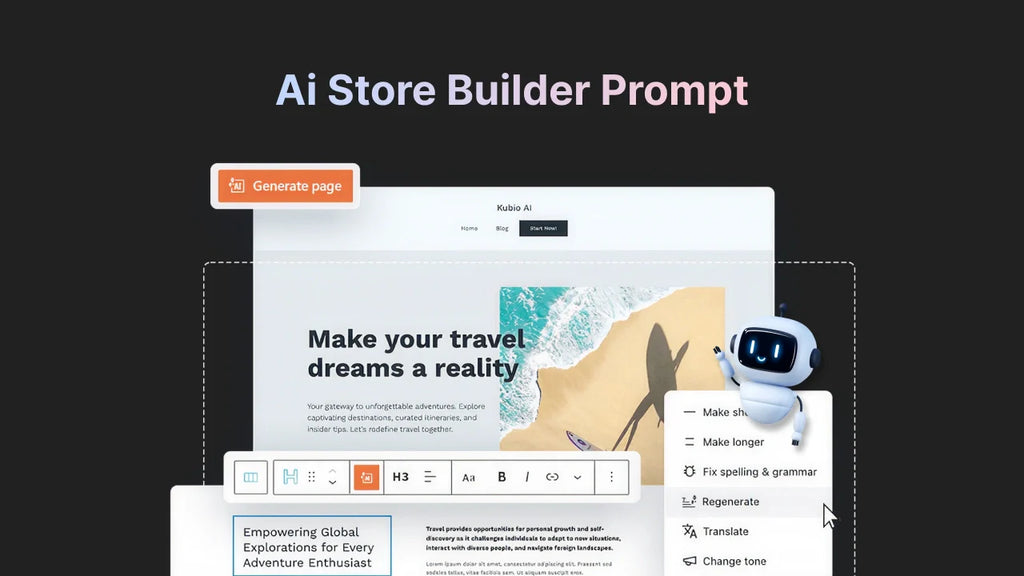
Most merchants assume AI store builders can instantly create a successful Shopify store. In reality, the quality of the store depends on the quality of the prompt.
A vague request often leads to generic branding, weak product positioning, and copy that looks like every other AI-generated store. A well-structured prompt gives AI the context it needs to generate more relevant ideas, stronger messaging, and a store built around your target audience.
In this guide, you'll find 100+ ready-to-use AI store builder prompts for Shopify, covering store setup, branding, product pages, SEO, marketing, and conversion optimization. Whether you're launching a new brand or improving an existing store, these prompts can help you move from idea to storefront much faster.
How to Write Effective AI Store Builder Prompts
Many merchants assume AI store builders fail because the technology isn't advanced enough. In reality, most poor outputs come from poor inputs.
A prompt like "build me a Shopify store" gives AI very little information to work with. The result is usually generic branding, broad product recommendations, and copy that could belong to almost any ecommerce business.
The best AI store builder prompts provide context, direction, and clear expectations. The more information you give the AI, the more useful its recommendations become.
Define Your Niche Clearly
Your niche is the foundation of every decision the AI will make.
Without a defined niche, AI tends to generate broad ecommerce concepts that lack differentiation. Instead of simply saying "fitness store" or "pet store," be as specific as possible.
For example, this prompt: "Create a Shopify store for fitness products."
will typically produce generic results.
A stronger prompt would be: "Create a Shopify store concept focused on premium recovery tools for runners aged 25-45 who train for marathons."
The second prompt immediately gives AI more context about the audience, product category, and market positioning.
Describe Your Target Audience
AI can only tailor messaging when it understands who the store is targeting.
Many ecommerce brands sell similar products but communicate with completely different audiences. A skincare brand targeting teenagers will sound very different from one targeting professionals in their 40s.
Include details such as:
-
Age range
-
Gender
-
Interests
-
Pain points
-
Goals
-
Shopping behavior
The clearer the audience profile, the more relevant the AI-generated branding, copy, and product recommendations will be.
Specify Your Brand Positioning
One of the biggest reasons AI-generated stores feel generic is the lack of brand positioning.
Tell the AI how you want your brand to be perceived.
For example:
-
Affordable and accessible
-
Premium and luxury
-
Sustainable and eco-friendly
-
Minimalist and modern
-
Fun and playful
Instead of asking AI to build a coffee brand, explain what makes the brand different from competitors and what customer perception you're trying to create.
Strong positioning leads to stronger branding, messaging, and design recommendations.
Include Product Information
The more AI understands your products, the better its outputs become.
Whenever possible, provide details such as:
-
Product names
-
Key features
-
Materials
-
Price range
-
Customer benefits
-
Competitive advantages
For example, if you're selling water bottles, don't simply say "water bottle."
Instead, explain that it's a 32-ounce insulated stainless steel bottle designed for hikers and travelers, with leak-proof construction and 24-hour cold retention.
Specific inputs almost always generate better outputs.
Request Specific Deliverables
Many prompts fail because the desired outcome isn't clearly defined.
Instead of asking: "Build a Shopify store." tell the AI exactly what you want.
For example: "Create a Shopify store concept including a brand name, tagline, homepage structure, collection hierarchy, target audience profile, and product page messaging."
The more specific the deliverables, the easier it becomes to generate useful results.
Refine Outputs Through Iteration
The first output is rarely the final output.
Experienced AI users treat prompting as a conversation rather than a one-time request.
After receiving an initial result, continue refining it.
You might ask the AI to:
-
Improve the brand positioning
-
Generate more premium brand names
-
Rewrite product copy
-
Create alternative homepage structures
-
Suggest stronger value propositions
The best Shopify store concepts often emerge after several rounds of refinement. Think of AI as a collaborator that improves with additional context rather than a tool that always produces the perfect answer on the first attempt.

AI Store Builder Prompts for Shopify Store Creation
AI store builders are most effective when given a clear business model and store objective. The prompts below are designed to generate complete store concepts that go beyond simple branding suggestions.
Feel free to replace the placeholders with information specific to your business before using them.
Complete Shopify Store Setup Prompt

Image by Pexels
Use this prompt when you want AI to create a complete Shopify store strategy from scratch.
Prompt: Act as a Shopify ecommerce consultant. Create a complete Shopify store plan for a business selling [product category]. Include:
-
Brand name ideas
-
Brand positioning
-
Target audience
-
Unique selling proposition
-
Homepage structure
-
Collection page structure
-
Navigation menu
-
Product page recommendations
-
SEO strategy
-
Marketing channels
-
Customer retention strategy
Present the output as a step-by-step Shopify store blueprint.
One-Product Store Prompt
This prompt is ideal for stores focused on a single hero product.
Prompt: Act as a direct-to-consumer ecommerce strategist. Create a Shopify one-product store concept for [product].
Include:
-
Brand positioning
-
Customer pain points
-
Key product benefits
-
Product page structure
-
Landing page sections
-
Upsell opportunities
-
FAQ recommendations
-
Trust-building elements
-
Marketing angles
Focus on maximizing conversion rates.
General Store Prompt
General stores require a different structure because they sell products across multiple categories.
Prompt: Act as a Shopify store strategist. Create a general ecommerce store selling trending products across multiple categories.
Recommend:
-
Brand concept
-
Store structure
-
Collection organization
-
Navigation menu
-
Homepage layout
-
Product selection criteria
-
Cross-selling strategy
-
Customer acquisition channels
Prioritize scalability and ease of management.
Niche Store Prompt
Niche stores typically perform better when targeting a clearly defined audience.
Prompt: Create a Shopify niche store for customers interested in [niche].
Include:
-
Audience profile
-
Brand positioning
-
Product categories
-
Homepage messaging
-
Collection structure
-
Content marketing opportunities
-
Email marketing ideas
-
Community-building strategies
Focus on creating a strong brand identity rather than competing on price.
Dropshipping Store Prompt

Use this prompt when launching a Shopify dropshipping business.
Prompt: Act as a dropshipping expert. Build a Shopify store strategy for a dropshipping business selling [product category].
Include:
-
Store positioning
-
Product selection criteria
-
Supplier evaluation framework
-
Homepage structure
-
Product page recommendations
-
Pricing strategy
-
Facebook and TikTok ad angles
-
Customer support workflows
-
Risk management recommendations
Prioritize profitability and long-term sustainability.
Print-on-Demand Store Prompt
Print-on-demand businesses require strong branding and audience alignment.
Prompt: Create a Shopify print-on-demand store concept targeting [audience].
Include:
-
Brand name ideas
-
Niche recommendations
-
Product lineup
-
Design themes
-
Homepage structure
-
Collection organization
-
Product page copy suggestions
-
Social media strategy
-
Influencer collaboration ideas
Focus on building a recognizable lifestyle brand.
Subscription Store Prompt
Subscription businesses depend heavily on retention and recurring revenue.
Prompt: Act as a subscription commerce consultant. Create a Shopify subscription store strategy for [product type].
Include:
-
Customer personas
-
Subscription model recommendations
-
Pricing structure
-
Homepage messaging
-
Product page structure
-
Customer retention strategy
-
Loyalty program ideas
-
Email automation workflows
-
Upsell opportunities
Focus on increasing customer lifetime value.
Luxury Brand Store Prompt
Luxury brands require a completely different positioning strategy than mass-market stores.
Prompt: Act as a luxury ecommerce brand strategist. Create a premium Shopify store for [product category].
Include:
-
Luxury brand positioning
-
Brand story
-
Premium customer profile
-
Homepage structure
-
Visual design direction
-
Product page recommendations
-
Pricing strategy
-
Customer experience recommendations
-
Exclusive marketing channels
Focus on prestige, craftsmanship, exclusivity, and brand perception rather than discounts or promotions.
AI Store Builder Prompts for E-commerce Branding
Many merchants use AI store builders primarily for product descriptions or marketing content. However, one of the most valuable applications of AI is brand development.
Before designing a homepage or launching ads, you need answers to fundamental questions:
-
What should the brand be called?
-
What does it stand for?
-
Who is it for?
-
How should it sound?
-
How should it look?
The prompts below can help AI generate stronger branding foundations that make the rest of the store-building process easier.
Brand Name Generation Prompt
Choosing a brand name is often one of the first challenges merchants face. A good name should be memorable, relevant to the audience, easy to pronounce, and flexible enough to support future growth.
Rather than asking AI to "generate brand names," provide context about your niche, audience, positioning, and desired brand personality.
Prompt: Act as a branding consultant. Generate 30 brand name ideas for a Shopify store selling [product category].
-
Target audience: [audience].
-
Brand personality: [modern, luxury, playful, minimalist, premium, etc.].
Avoid generic ecommerce names and focus on names that are:
-
Memorable
-
Easy to pronounce
-
Available as a potential domain
-
Relevant to the niche
-
Scalable for future product expansion
Categorize the names into premium, modern, and creative options.

You can try the Business Name Generator by Shopify
Brand Story Prompt
Many AI-generated stores feel generic because they focus only on products and ignore storytelling.
A strong brand story creates emotional context around why the business exists and why customers should care.
This prompt is especially useful when building a DTC brand rather than a simple product catalog.
Prompt: Act as a brand strategist. Create a compelling brand story for a Shopify brand that sells [product category].
Include:
-
The problem the brand exists to solve
-
The founder's motivation
-
The customer's challenge
-
The transformation the product provides
-
The long-term vision of the company
Write in a way that feels authentic and customer-focused rather than corporate.
Brand Mission Prompt
Many stores confuse a mission statement with a slogan.
A mission explains the purpose behind the business and often influences messaging, product development, and customer experience.
This prompt helps create a mission that goes beyond simply "selling products."
Prompt: Act as a brand strategist. Create a mission statement for a Shopify store selling [product category].
-
Target audience: [audience].
-
Core values: [values].
Focus on:
-
Why the company exists
-
Who it serves
-
The impact it wants to create
-
Long-term customer value
Generate:
-
One mission statement
-
One vision statement
-
Three alternative versions with different tones
Brand Voice Prompt
One of the biggest reasons AI-generated content feels robotic is inconsistent brand voice.
Before generating product descriptions, ads, or emails, define how the brand should communicate.
The output from this prompt can become the foundation for future AI workflows.
Prompt: Act as a brand messaging consultant. Create a complete brand voice guide for a Shopify store selling [product category].
-
Audience: [audience].
-
Positioning: [positioning].
Include:
-
Brand personality traits
-
Tone of voice guidelines
-
Writing style recommendations
-
Words to use frequently
-
Words to avoid
-
Example product description
-
Example social media caption
-
Example email message
Make the voice consistent across all customer touchpoints.
Tagline Generation Prompt
A tagline should communicate value quickly and reinforce brand positioning.
The strongest taglines are usually short, memorable, and focused on outcomes rather than products.
Prompt: Generate 50 tagline ideas for a Shopify brand selling [product category].
-
Brand positioning: [positioning].
-
Audience: [audience].
Create tagline options that are:
-
Emotional
-
Benefit-focused
-
Premium
-
Minimalist
-
Aspirational
Categorize them by style and explain the strategic thinking behind the strongest options.
Color Palette Prompt
Most AI store builders can generate visual recommendations, but those recommendations improve significantly when tied to brand strategy.
This prompt helps connect design decisions to customer perception.
Prompt: Act as a branding and ecommerce design expert. Recommend a complete color palette for a Shopify store selling [product category].
-
Brand personality: [personality].
-
Target audience: [audience].
Include:
-
Primary color
-
Secondary colors
-
Accent colors
-
CTA button colors
-
Background colors
-
Text colors
Explain how each color influences customer perception and purchasing behavior.
Logo Concept Prompt

You can try Shopify Logo Maker
AI image generators can create logos, but they often need strategic direction first.
This prompt generates the creative brief before moving into visual creation.
Prompt: Act as a brand identity designer. Create 10 logo concepts for a Shopify brand selling [product category].
-
Brand personality: [personality].
-
Audience: [audience].
For each concept, provide:
-
Logo style
-
Visual symbolism
-
Typography recommendations
-
Color recommendations
-
Brand message communicated
Focus on concepts that can scale across ecommerce websites, social media, packaging, and advertising materials.
The most successful ecommerce brands don't start with logos or color palettes. They start with positioning, audience understanding, and a clear brand identity. These prompts help AI establish that foundation before moving on to store design, product pages, and marketing campaigns.
Read more: Best AI Powered Logo Generator: 10+ Tested Option for 2026
AI Store Builder Prompts for Shopify Product Pages
Product pages are where branding, marketing, and conversion optimization come together.
Many merchants use AI to generate product descriptions, but that only scratches the surface. A well-structured AI prompt can help create product messaging, identify customer pain points, develop stronger positioning, generate FAQs, and even plan the structure of the page itself.
The prompts below are designed to help Shopify merchants build more persuasive product pages rather than simply filling space with generic copy.
Product Description Prompt
One of the most common mistakes merchants make is asking AI to "write a product description."

You can try AI Content Generator with GemAI by GemPages
The result is usually a list of features with little understanding of the customer or buying motivation.
A stronger prompt provides context about the audience, product benefits, and desired tone.
Prompt: Act as a senior ecommerce copywriter. Write a Shopify product description for [product name].
-
Target audience: [audience].
-
Product features: [features].
-
Key customer pain points: [pain points].
-
Desired tone: [tone].
Structure the description with:
-
Problem-focused introduction
-
Key benefits section
-
Feature explanation
-
Emotional buying triggers
-
Call to action
Focus on customer outcomes rather than simply listing features.
Feature-to-Benefit Prompt
Features rarely sell products on their own. Customers care more about what those features mean for their lives. This prompt helps transform technical specifications into customer-focused messaging.
Prompt: Act as a direct-response copywriter. Convert the following product features into customer benefits.
For each feature:
-
Explain why it matters
-
Identify the problem it solves
-
Describe the desired outcome
-
Use customer-friendly language
Product features: [Insert features] Present the output in a table with Feature, Benefit, Problem Solved, and Customer Outcome columns.
Product USP Prompt
Many stores sell similar products.
The challenge is identifying what makes your offer different.
A USP (Unique Selling Proposition) helps clarify why customers should choose your product instead of a competitor's.
Prompt: Act as an ecommerce strategist. Analyze the following product: [Product information]
Target audience: [Audience]
Competitors: [Competitors]
Generate:
-
10 potential unique selling propositions
-
Supporting proof points
-
Customer-focused messaging angles
-
Differentiation opportunities
Focus on positioning that competitors are not emphasizing.
Product Comparison Prompt
Comparison content is one of the most effective tools for helping customers make decisions.
It also works well for high-consideration purchases where shoppers actively compare alternatives.
Prompt: Compare [Product A] and [Product B]. Create:
-
Comparison table
-
Feature differences
-
Benefit differences
-
Ideal customer profiles
-
Strengths and weaknesses
-
Recommendation by customer type
End with a summary explaining which customers should choose each product.
FAQ Prompt
FAQs help address objections before customers leave the page.
Rather than manually brainstorming questions, merchants can use AI to identify concerns shoppers are likely to have.
Prompt: Act as a Shopify customer experience specialist. Create 20 frequently asked questions for [product].
Cover:
-
Product usage
-
Shipping
-
Returns
-
Sizing
-
Materials
-
Compatibility
-
Maintenance
-
Product performance
Provide concise, customer-friendly answers that build trust and reduce purchase hesitation.
Product Image Brief Prompt
Many merchants overlook the fact that AI can help plan product photography as well.
Strong visuals often influence conversions more than copy.
This prompt generates a creative brief that can be used by photographers, designers, or AI image-generation tools.
Prompt: Act as an ecommerce creative director. Create a complete product photography brief for [product].
Include:
-
Hero image concepts
-
Lifestyle photography ideas
-
Product detail shots
-
Comparison images
-
Product-in-use images
-
User-generated content concepts
-
Mobile-first image recommendations
Explain the purpose of each image and where it should appear on the product page.
Product Page Wireframe Prompt
Most AI-generated product pages fail because they focus only on copy.
High-converting pages require structure.
This prompt helps create the overall page layout before content production begins.
Prompt: Act as a CRO specialist and Shopify UX designer. Create a high-converting product page wireframe for [product].
Target audience: [Audience]
Product type: [Product]
Include:
-
Hero section
-
Product gallery
-
Benefits section
-
Feature section
-
Social proof
-
Comparison table
-
FAQ section
-
Trust-building elements
-
CTA placement
-
Mobile optimization recommendations
Explain the purpose of each section and how it contributes to conversion rate optimization.
One of the biggest opportunities with AI store builders is using them to plan product pages before design work begins. The best-performing Shopify product pages are rarely the result of a single prompt. Instead, merchants combine multiple prompts to develop positioning, messaging, visuals, page structure, and conversion strategy before moving into implementation.
AI Store Builder Prompts for Shopify Collections
Collection pages often receive less attention than product pages, but they play a critical role in both SEO and product discovery.
A well-organized collection structure helps customers find products faster, improves internal linking, and creates more opportunities to rank for commercial-intent keywords. AI store builders can assist with everything from collection planning to SEO optimization when given the right instructions.
The prompts below focus on helping merchants create collection pages that are easier to navigate and more effective at driving conversions.
Collection Structure Prompt
Many Shopify stores organize products based on internal business logic rather than how customers actually shop.
AI can help identify collection structures that better match customer intent and browsing behavior.
Prompt: Act as an ecommerce merchandising strategist. Create a Shopify collection structure for a store selling [product category].
Target audience: [audience].
Product catalog: [list products or categories]
Recommend:
-
Primary collections
-
Subcollections
-
Seasonal collections
-
Best-seller collections
-
Problem-solution collections
-
Cross-selling opportunities
Explain the reasoning behind each collection and how it improves customer navigation.
Collection Description Prompt
Collection descriptions are often overlooked, yet they can improve both SEO and customer experience.
Instead of publishing generic text, use AI to create descriptions that explain the collection's purpose and help shoppers make informed decisions.
Prompt: Act as an ecommerce SEO copywriter. Write a collection page description for a Shopify collection called "[collection name]".
-
Target audience: [audience].
-
Primary keyword: [keyword].
Include:
-
Collection overview
-
Types of products available
-
Buying considerations
-
Customer benefits
-
Natural keyword integration
Write between 250–400 words while maintaining a customer-focused tone.
Collection SEO Prompt
Collection pages are often some of the strongest SEO assets in a Shopify store because they target high-intent commercial keywords.
This prompt helps identify opportunities to improve search visibility.
Prompt: Act as a Shopify SEO consultant. Analyze the collection page for "[collection name]".
Target keyword: [keyword].
Provide recommendations for:
-
SEO title
-
Meta description
-
Heading structure
-
Collection description improvements
-
Internal linking opportunities
-
Related keyword targets
-
User experience improvements
Prioritize recommendations based on expected SEO impact.
Product Categorization Prompt
As product catalogs grow, categorization becomes increasingly difficult.
Poor categorization creates navigation issues, weak collection pages, and a frustrating shopping experience.
This prompt helps merchants organize products more effectively.
Prompt: Act as an ecommerce merchandising specialist. Review the following products:[product list]
Recommend:
-
Primary categories
-
Subcategories
-
Collection assignments
-
Product tags
-
Filter options
-
Cross-category opportunities
Structure the recommendations from a customer shopping perspective rather than an internal business perspective.
Navigation Optimization Prompt
Even a well-designed store can struggle if customers cannot easily find products.
Navigation optimization is one of the highest-impact improvements merchants can make, especially as catalogs expand.
Prompt: Act as a Shopify UX consultant. Analyze the navigation structure of a Shopify store selling [product category]. Current collections: [collection list]
Recommend improvements for:
-
Main navigation
-
Dropdown menus
-
Collection hierarchy
-
Search experience
-
Product discovery
-
Mobile navigation
-
Internal linking
Provide a revised navigation structure designed to improve customer experience and conversion rates.
Strong collection pages are rarely created by accident. They are the result of thoughtful organization, clear categorization, and an understanding of how customers browse products. These prompts can help AI generate collection strategies that improve both discoverability and store performance before you begin building or redesigning your Shopify storefront.
AI Store Builder Prompts for Shopify SEO
Many merchants think SEO starts with publishing blog posts. In reality, SEO influences nearly every part of a Shopify store, from homepage messaging and collection organization to product pages and content strategy.
AI can significantly accelerate SEO workflows when prompts are specific and tied to business objectives. Instead of asking AI to "optimize my SEO," use prompts that focus on individual assets and outcomes.
The prompts below can help merchants improve search visibility while creating content that remains useful for customers.
Homepage SEO Prompt
The homepage often serves as the authority hub of a Shopify store. It communicates brand positioning, introduces product categories, and supports important keywords that define the business.
AI can help identify optimization opportunities while ensuring the homepage remains customer-focused rather than keyword-stuffed.
Prompt: Act as a Shopify SEO consultant. Analyze a Shopify homepage for a store selling [product category]. Target keywords: [keywords]
Generate recommendations for:
-
Homepage headline
-
Supporting copy
-
SEO title
-
Meta description
-
Internal linking opportunities
-
Trust-building content
-
User experience improvements
Balance SEO optimization with conversion-focused messaging.
Product Page SEO Prompt
Product pages often target some of the most valuable commercial keywords in an ecommerce store.
However, many merchants publish manufacturer descriptions or thin content that provides little opportunity to rank.
This prompt helps improve both search visibility and conversion potential.
Prompt: Act as an ecommerce SEO specialist.
Analyze the following product: [product information]
Target keyword: [keyword]
Generate:
-
SEO title
-
Meta description
-
Optimized product description
-
Heading structure
-
Semantic keyword recommendations
-
FAQ opportunities
-
Internal linking suggestions
Focus on improving both rankings and conversions.
Collection SEO Prompt
Collection pages frequently target broad commercial keywords such as:
-
Running shoes
-
Organic skincare
-
Protein powder
-
Standing desks
Because of their category-level relevance, they can become major SEO traffic drivers.
Prompt: Act as a Shopify collection page SEO expert. Optimize a collection page targeting: [keyword]
Collection name: [collection name]
Recommend:
-
Collection description
-
SEO title
-
Meta description
-
Supporting keywords
-
FAQ opportunities
-
Internal linking recommendations
-
Collection page content structure
Prioritize search intent and user experience.
Meta Title Prompt
Writing meta titles at scale can become time-consuming, particularly for stores with hundreds of products and collections.
AI can quickly generate multiple variations for testing and optimization.
Prompt: Generate 20 SEO-friendly meta title options for: [page type]
Primary keyword: [keyword]
Requirements:
-
Under 60 characters
-
Include the primary keyword
-
Maximize click-through rate
-
Avoid keyword stuffing
Categorize results by style (informational, commercial, benefit-focused, and brand-focused).
Meta Description Prompt
Although meta descriptions do not directly influence rankings, they can significantly impact click-through rates.
Strong descriptions encourage users to choose your page over competing search results.
Prompt: Create 20 meta description variations for: [page]
Target keyword: [keyword]
Requirements:
-
Under 155 characters
-
Include the target keyword naturally
-
Highlight customer benefits
-
Encourage clicks
Generate versions focused on urgency, value, trust, and product benefits.
Blog Content Prompt
Blog content can support SEO by targeting informational keywords that customers search before making a purchase.
Rather than asking AI to write entire articles immediately, use it to create stronger content briefs and outlines first.
Prompt: Act as an ecommerce content strategist. Create a complete SEO content brief for the keyword: [keyword]
Include:
-
Search intent analysis
-
Recommended title
-
H2 and H3 structure
-
Supporting keywords
-
Frequently asked questions
-
Internal linking opportunities
-
Conversion opportunities
The content should support both organic traffic growth and ecommerce sales.
Keyword Cluster Prompt
One of the most valuable uses of AI for SEO is identifying content ecosystems rather than isolated keywords.
Keyword clusters help merchants build topical authority and create stronger internal linking structures.
Prompt: Act as a Shopify SEO strategist. Create a keyword cluster around: [main keyword]
Generate:
-
Pillar page topics
-
Supporting blog topics
-
Product page opportunities
-
Collection page opportunities
-
Related long-tail keywords
-
Search intent categorization
Organize the results into a content roadmap that supports long-term organic growth.
Many AI store builders focus on generating content, but the most successful merchants use AI to support strategy as well. By combining these prompts with keyword research and customer insights, Shopify store owners can create SEO systems that extend far beyond individual pages and contribute to sustainable organic growth.
AI Store Builder Prompts for Ecommerce Marketing
Launching a Shopify store is only the beginning. Once products and pages are live, merchants still need a reliable way to attract visitors, generate demand, and drive conversions.
This is where AI can become a valuable marketing assistant.
Instead of spending hours brainstorming ad concepts, writing email campaigns, or creating promotional content, merchants can use AI prompts to generate marketing assets much faster. The key is providing enough context so the outputs feel relevant to the product, audience, and brand.
The prompts below cover some of the most common ecommerce marketing activities for Shopify stores.
Facebook Ad Prompt
Facebook and Instagram remain two of the most important customer acquisition channels for ecommerce brands.
The challenge is that successful campaigns often require multiple creative angles, headlines, and messaging variations for testing.
Rather than creating each variation manually, AI can generate dozens of ideas in minutes.
Prompt: Act as a Facebook advertising strategist for ecommerce brands. Create 10 Facebook ad concepts for:
-
Product: [product]
-
Target audience: [audience]
-
Key benefits: [benefits]
-
Brand voice: [tone]
For each concept, provide:
-
Primary text
-
Headline
-
CTA
-
Hook angle
-
Customer pain point addressed
Include a mix of emotional, problem-solution, social proof, and benefit-driven approaches.
Google Ad Prompt
Google Ads require a different approach because users are actively searching for solutions.
The goal is to align messaging with purchase intent while maximizing click-through rates.
Prompt: Act as a Google Ads specialist. Create:
-
20 headlines
-
10 descriptions
-
5 value propositions
For:
-
Product: [product]
-
Target keyword: [keyword]
-
Audience: [audience]
Ensure all copy follows Google Ads best practices and emphasizes customer benefits over product features.
TikTok Ad Prompt
Many ecommerce brands struggle on TikTok because they approach it like traditional advertising.
Successful TikTok content feels native to the platform rather than overly promotional.
This prompt helps generate ideas that align with short-form content formats.
Prompt: Act as a TikTok ecommerce creative strategist. Create 10 TikTok ad concepts for:
-
Product: [product]
-
Audience: [audience]
For each concept include:
-
Hook
-
Video concept
-
Key talking points
-
CTA
-
Suggested creator style
Prioritize content that feels organic rather than sales-focused.
Influencer Outreach Prompt
Finding influencers is only half the challenge.
Many partnership opportunities are lost because outreach messages feel generic or transactional.
A personalized message significantly improves response rates.
Prompt: Act as an influencer marketing manager. Write an outreach email for:
-
Brand: [brand]
-
Product: [product]
-
Influencer niche: [niche]
Include:
-
Personalized introduction
-
Collaboration proposal
-
Product value proposition
-
Partnership benefits
-
Clear next steps
Maintain a professional but friendly tone.
Email Welcome Sequence Prompt
The first few emails often determine whether a subscriber becomes a customer.
A strong welcome sequence introduces the brand, builds trust, and encourages initial purchases without being overly aggressive.
Prompt: Act as an ecommerce email marketing strategist. Create a 5-email welcome sequence for:
-
Brand: [brand]
-
Product category: [category]
-
Audience: [audience]
Include:
-
Email subject lines
-
Email objectives
-
Main message
-
CTA recommendations
Focus on building trust before selling.
Product Launch Campaign Prompt
Product launches often involve multiple channels and customer touchpoints.
Instead of creating campaigns piece by piece, AI can help develop a coordinated launch strategy.
Prompt: Act as a DTC launch strategist. Create a complete product launch campaign for:
-
Product: [product]
-
Audience: [audience]
Include:
-
Launch timeline
-
Email campaign ideas
-
Social media content
-
Facebook ad angles
-
Influencer opportunities
-
Landing page recommendations
-
Promotional offers
Structure the campaign into pre-launch, launch week, and post-launch phases.
Seasonal Promotion Prompt
Holiday campaigns often require fresh messaging every year.
Whether you're planning Black Friday, Cyber Monday, Valentine's Day, or a summer sale, AI can generate new promotional angles quickly.
Prompt: Act as an ecommerce campaign strategist. Create a seasonal marketing campaign for:
-
Holiday/Event: [event]
-
Product category: [category]
-
Audience: [audience]
Include:
-
Campaign theme
-
Promotional offer ideas
-
Email marketing concepts
-
Social media content ideas
-
Landing page messaging
-
Ad copy angles
-
Urgency tactics
Focus on maximizing conversions while maintaining brand consistency.
One of the biggest advantages of AI store builders is that they can support marketing long after the store is launched. Instead of using AI only during setup, successful merchants integrate these prompts into their ongoing marketing workflows to generate ideas, accelerate campaign execution, and maintain a steady stream of content across multiple channels.
AI Store Builder Prompts for Conversion Optimization
Building a Shopify store is only the first step. The real challenge is turning visitors into customers.
Many merchants focus heavily on generating product descriptions, branding assets, and marketing content with AI, but overlook one of its most valuable applications: conversion optimization.
AI can act as a virtual CRO consultant, helping identify friction points, uncover customer objections, analyze user experience issues, and generate recommendations for improving performance.
The prompts below can help merchants audit key areas of their store and discover opportunities to increase conversion rates.
Homepage Audit Prompt
Your homepage is often the first impression visitors have of your brand.
A weak homepage can create confusion, reduce trust, and cause visitors to leave before exploring products.
AI can evaluate whether the page effectively communicates value and guides users toward meaningful actions.
Prompt: Act as a senior ecommerce CRO specialist. Audit the homepage of my Shopify store:[Homepage URL]
Evaluate:
-
Hero section effectiveness
-
Value proposition clarity
-
Navigation structure
-
Trust signals
-
Product merchandising
-
Mobile experience
-
CTA placement
-
Visual hierarchy
Identify the top 10 conversion bottlenecks and provide actionable recommendations ranked by potential impact.
Product Page Audit Prompt
Product pages are often the highest-leverage pages in an ecommerce store because they directly influence purchasing decisions.
This prompt helps identify areas where product pages may be losing potential customers.
Prompt: Act as an ecommerce conversion rate optimization consultant. Audit the following Shopify product page: [Product Page URL]
Analyze:
-
Product imagery
-
Product description
-
Pricing presentation
-
Reviews and social proof
-
Trust-building elements
-
CTA visibility
-
Mobile experience
-
Objection handling
Highlight strengths, weaknesses, and specific recommendations to improve conversion rates.
Landing Page Audit Prompt
Landing pages often receive traffic from paid ads, influencers, email campaigns, and social media promotions.
Because these visitors arrive with a specific expectation, even small issues can significantly impact performance.
Prompt: Act as a direct-response landing page expert. Audit the following Shopify landing page:
[Landing Page URL]
Evaluate:
-
Message match
-
Headline effectiveness
-
Offer clarity
-
Visual flow
-
Social proof
-
CTA placement
-
Mobile optimization
-
Overall conversion potential
Provide a detailed CRO report with prioritized recommendations.
Checkout Optimization Prompt
A customer who reaches checkout has already demonstrated strong purchase intent.
However, unnecessary friction during checkout can still lead to lost sales.
This prompt focuses on identifying barriers that may prevent customers from completing their purchases.
Prompt: Act as a Shopify checkout optimization specialist. Review the following checkout process: [Checkout screenshots or description]
Identify:
-
Friction points
-
Potential trust issues
-
Form complexity
-
Shipping concerns
-
Payment obstacles
-
Mobile usability issues
Recommend improvements that could increase checkout completion rates.
Cart Abandonment Analysis Prompt
Cart abandonment is one of the most common ecommerce challenges.
AI can help identify patterns and generate strategies for recovering otherwise lost revenue.
Prompt: Act as an ecommerce retention strategist. Analyze the following cart abandonment data: [Analytics, survey responses, or customer feedback]
Identify:
-
Likely abandonment causes
-
Customer objections
-
Pricing concerns
-
Shipping-related issues
-
User experience problems
Recommend tactics to reduce cart abandonment and improve purchase completion.
Customer Review Analysis Prompt
Customer reviews contain valuable insights that many merchants overlook.
Beyond social proof, reviews can reveal recurring pain points, customer motivations, product strengths, and messaging opportunities.
AI can process large volumes of reviews much faster than manual analysis.
Prompt: Act as a customer insights analyst. Analyze the following customer reviews: [Paste reviews]
Identify:
-
Most common positive themes
-
Most common complaints
-
Frequently mentioned benefits
-
Customer language patterns
-
Product improvement opportunities
-
Marketing angles that should be emphasized
Summarize the findings and provide recommendations for improving both product pages and marketing campaigns.
The most successful Shopify merchants don't use AI only for content creation. They also use it to evaluate performance, identify weaknesses, and uncover optimization opportunities. Combined with analytics tools and real customer data, these prompts can help transform AI from a content generator into a practical conversion optimization assistant.
Building a Better Shopify Store With AI with GemPages
AI store builders can dramatically reduce the time required to launch a Shopify store.
They can generate brand names, write product descriptions, suggest collection structures, create SEO content, and even help plan marketing campaigns. For many merchants, this eliminates hours of manual work during the early stages of building a business.
However, there is one area where AI still faces limitations: page design.
Most AI tools can generate content, but they cannot automatically create a conversion-focused storefront experience tailored to your customers, products, and campaigns.
A successful Shopify store requires more than words on a page. It needs visual hierarchy, compelling layouts, trust-building sections, persuasive product presentation, and a customer journey that encourages action.
This is where GemPages complements AI particularly well.
AI Creates the Content. GemPages Creates the Experience.
Think of AI as your content strategist and GemPages as your visual builder.
AI can generate:
-
Product descriptions
-
Brand messaging
-
SEO content
-
Ad copy
-
Collection descriptions
-
Landing page copy
-
Email campaigns
But that content still needs to be transformed into an engaging shopping experience.
With GemPages, merchants can visually build:
-
Homepages
-
Product pages
-
Collection pages
-
Landing pages
-
Product launch pages
-
Seasonal campaign pages
-
Promotional funnels
without relying on developers or custom code.

Why Layout Matters More Than Most Merchants Realize
Many stores use AI-generated content but place it inside generic theme templates.
As a result, the messaging may improve while the customer experience remains unchanged.
Page layout directly influences:
-
Product discovery
-
Visitor engagement
-
Trust building
-
Information consumption
-
Conversion rates
For example, AI might generate a compelling value proposition, but its impact depends on where it appears on the page, what visuals support it, and how easily customers can act on it.
The same product description can perform very differently depending on the surrounding design.
A Practical AI + GemPages Workflow
Many Shopify merchants now use AI and GemPages together rather than viewing them as competing tools.
A typical workflow looks like this:
Step 1: Use AI to generate store assets.
Create brand positioning, product descriptions, collection content, FAQs, SEO copy, and marketing campaigns.
Step 2: Build custom pages with GemPages.
Use the generated content to create homepages, landing pages, product pages, and promotional experiences.
Step 3: Customize layouts visually.
Add sections such as:
-
Hero banners
-
Product showcases
-
Testimonials
-
Trust badges
-
Comparison tables
-
FAQs
-
Countdown timers
-
Upsell sections
Step 4: Optimize for conversion.
Refine the page structure based on customer behavior, campaign goals, and performance data.
Instead of spending weeks moving from concept to launch, merchants can dramatically accelerate the process by combining AI-generated content with GemPages' drag-and-drop design flexibility.
From AI Store Builder to High-Converting Storefront
The most successful Shopify stores rarely rely entirely on automation.
AI can help generate ideas and content quickly, but conversion-focused experiences still require thoughtful design and customization.
By combining AI with GemPages, merchants can move beyond basic AI-generated storefronts and create shopping experiences that are aligned with their brand, audience, and business goals.
The result is a faster workflow, greater creative control, and a store that is better positioned to convert traffic into revenue.
Conclusion
AI store builders have made it easier than ever to launch a Shopify store. From branding and product pages to SEO and marketing campaigns, AI can accelerate many of the tasks that traditionally required significant time and effort.
However, the quality of the output depends heavily on the quality of the prompt. The most effective merchants treat AI as a strategic assistant, providing clear instructions, detailed context, and specific objectives.
The prompts in this guide can help streamline store creation, content production, marketing execution, and conversion optimization. When combined with tools like GemPages, merchants can go beyond generating content and start building complete ecommerce experiences designed to attract customers and drive sales.
FAQs