Facebook Community
 Change Log
 Help Center


10+ Best Shopify Blog Examples You’ll Want to Copy in 2026

There’s a plethora of ways to drive traffic to your online business, with paid advertising often coming out on top of the list. As evident as the benefits of paid social media ads are, there is a widely underrated tool that Shopify store owners should use to its fullest potential: blogging. Underrated is, well, an understatement, since some eCommerce hustlers may still be wondering how to add a blog to Shopify.
In short, this is a golden opportunity for you to make a remarkable impression with your blog posts, thus driving organic traffic to your very online store. If you have a general idea but are unsure where and how to begin, keep reading for our list of the best Shopify blog examples that will inspire you and encourage you to start with your own blogging adventure.

Benefits of Having A Blog for Your Shopify Store
Think of the blog page as the cherry on top of your Shopify-branded cupcake.
Perfecting the home and product pages is great, but having another source that helps assist both the newcomers and regulars will give you that edge over the competitors in the same field. When someone is searching for a quick answer, being able to provide them with accurate and useful information is key.
Being one step ahead of even the most trusted news sources will greatly raise brand awareness and take you further to becoming a more recognizable business.
So, what are the exact benefits of blogging? Let’s check it out.
1. To capture organic traffic with great SEO
Ad clicks are great, but if the resources have run out, they will eventually disappear as well. Blogging is a powerful tool for driving organic traffic through free clicks to your eCommerce store. But not just any blog content. Engaging, trustworthy, and relevant content can attract visitors to your website and encourage them to explore your products.
2. Build trust as a thought leader
This is a perfect opportunity to establish your knowledge and expertise within the industry, thus becoming a thought leader. Over time, a formidable bonding of trust will be built between your audience and your business.
3. Build brand awareness and personality
Blogging is your thoughts and experiences in written form, after all. Feel free to tell your story, showcase your products, and share your knowledge as authentically as possible. By creating content that resonates with your target audience, you can attract new customers and build a loyal following.
4. Improve SEO
Needless to say, search engines love fresh, high-quality content, and a blog is the perfect medium to convey just that. By optimizing your Shopify blog for SEO, you can improve your search engine rankings and attract more organic traffic to your website. This also calls for regular maintenance of your blog posts, so do not let a post sit untouched for a year at a time.
5. Engage with existing customers
Sales can come from both new and existing customers. Therefore, it is a costly mistake to neglect your already-established customer base. Blog content that caters to people who already own your products is equally as important as content for new visitors. After-care instructions or brand updates being sent straight to their inbox will likely prompt them to revisit your store and buy again.
6. Drive sales
Every person who visits your store from an article on the search result page is a potential lead. If you are able to provide the exact answer to their question, there is a high chance that sales and revenue will be generated for your eCommerce store after that string of actions.
Learn more: How to Make Money with SEO: Opportunities for Everyone
11 Best Shopify Blog Examples That You Will Want to Copy
Learn from the best, as they said. To save you the time and effort of researching yourself, our team has curated some of the most successful Shopify businesses that are making use of blogging to establish their brand and drive traffic and profits. If all the cool kids are doing it, why aren’t you?
Shopify blog examples at a glance
These stores use different content models, from search-led education to founder stories. Use the table below to find the approach that best matches your products, audience, and sales journey.
| Store | Niche | Content approach | Blog structure | Conversion path | Best pattern to copy |
|---|---|---|---|---|---|
| Pure Matcha | Tea and teaware | Brewing guides, recipes, and local content | Three clear topic categories | Relevant products within educational posts | Build content clusters around distinct search needs |
| Beavertown Brewery | Beer | Beer education, gift ideas, and local recommendations | Visual article feed with custom thumbnails | Product links after useful guides | Carry a recognizable brand style into every post |
| Goose Studios | Sustainable fashion | Founder-led stories, sustainability, and culture | Simple three-column article grid | Community and brand affinity | Use a distinct point of view when search traffic is not the only goal |
| Connected Apparel | Women’s fashion | What-to-wear and clothing care guides | Large archive organized as a visual feed | Styling advice leads naturally to products | Turn recurring customer questions into evergreen guides |
| Korean Skincare | Beauty and skincare | Search-led education for common skincare questions | Broad topic library with featured posts | Visual product recommendations and clear calls to action | Connect beginner education to the next relevant product |
| Fluxies | Period underwear | Problem-solving articles about periods and product use | Readable article layout with comments | Helpful content supports direct product discovery | Use on-site discussion to deepen engagement |
| Beardbrand | Men’s grooming | Detailed grooming advice and founder perspectives | Nine topic hubs with named authors | Products appear only when they solve the problem | Build trust through honest advice, bylines, and clear expertise |
| Game of Bricks | LEGO lighting kits | Gift guides, product reviews, and hobby news | Frequently updated enthusiast-focused feed | Reviews and self-taken photos support product discovery | Serve a focused community with hands-on content |
| Rainbow Vision | Paper goods and gifts | Founder stories and journal-style posts | Small, personal editorial feed | Brand loyalty and community connection | Use personal stories when your brand voice is the main differentiator |
| American Girl | Dolls and children’s products | Stories, crafts, recipes, and podcasts | Visual, multimedia content library | Products become characters within the content | Match the format and design to the audience’s interests |
| Au Lit Fine Linens | Bedding and home | Search-led styling and sleep advice | Editorial posts built around practical questions | Contextual product links inside the article | Place product links where they illustrate the advice |
F&B Shopify Blog Examples
1. Pure Matcha
Pure Matcha, an Australia-based business, offers all things matcha, green tea, and teaware products. The use of simple layout web design gives their store a calming feel, where visitors can freely explore as they go without being bombarded with a million pop-ups.
This design choice also translates into their blog page.
Their Shopify blog posts are separated into three categories: brewing guides, learning tea, and matcha recipes & news. This clever strategy helps their store appear in more search results via blog posts that answer questions ranging from “how to store matcha and green tea” to “matcha bubble tea recipe”. Pure Matcha also cleverly leans into writing locally—with articles revolving around the best matcha and tea spots in cities across Australia.

Pure Matcha goes locally with their blog post
What’s special: Despite the name, Pure Matcha has a wide variety of other tea-adjacent goods. These products are neatly displayed in their blog posts on many subjects, which simultaneously still provide reliable information. When a potential customer decides to make a purchase, they will feel compelled to add the other merchandise to their cart too.
Learn more: 18 Best One Product Shopify Store Examples
2. Beavertown Brewery
No matter which page you have been introduced to, the Beavertown Brewery website will be a surefire eye-catcher with its splashy layout.
 The colorful blog posts of Beavertown Brewery.
The Beavertown folks know their niche, and they are masters at delivering exactly what their customers want. Beer enthusiasts are sure to be impressed with their comprehensive beer master guide, with their products linked directly at the bottom of the page.
Beer gift ideas for different holidays and local pub recommendations are also helpful content to keep existing customers interested as well as to turn first-time visitors into frequenters. This eCommerce store definitely has one of the most outstanding Shopify blog post examples on the block.
What’s special: The brand took the time to personalize every thumbnail for their blog posts, which adds professionalism and charm to the whole brand’s aesthetic. If you’ve got your hands full with other factors while setting up your Shopify store, websites such as Unsplash and Shutterstock are always good sources for free images.
Shopify Blog Examples for Fashion Stores
3. Goose Studios
Goose Studios is not just a regular clothing store. Its founders specifically aimed to create an apparel brand that is 100% ethically and organically sourced. This mantra has a major influence on how they do their business, and instead of focusing on driving sales at any given chance, they opt to encourage their customers to only buy when needed.

Goose Studios’ business objective and mantra
With the planet’s best interest in mind, their Shopify blog posts are not always SEO-focused. Alongside sustainable clothing lists and fashion top picks, the founders wrote about sustainability news and shared music recommendations under their own names.
That mix gave the brand a voice readers could recognize, which is what kept them coming back. Worth knowing before you copy it: their newest post dates to November 2025, so treat this as a study in voice rather than in publishing cadence.

Goose Studios cover different topics with their blog posts
The whole website gives out a modern and aesthetically pleasing impression consistently across all pages. The blog posts are spread into three columns, which averts crowdedness or excessive scrolling.
What’s special: Some brands put driving traffic and sales at their core, and some don’t. Goose Studios’ priority is not to appear in every search result but more to build a tight-knit community of environmentally conscious buyers through their blog posts. This paints the brand in a positive light and makes it stand out among the crowd.
Learn more: How to Sell Music on Shopify
4. Connected Apparel
The Connected Apparel clothing brand celebrates women of all shapes and sizes, without an age limit. They have an eye for contemporary fashion pieces with a simplistic design.
However, their blogging content is no plain Jane. The brand built a well-suited SEO strategy around enticing titles and topics that highlight their products. The archive runs to 14 pages, though the newest post dates to April 2025, so read it as a library of title patterns rather than a live publishing example.
The soothing beige, white, and black color combination conveys a sleek and modern feel to the whole website, while their self-taken photo shoots promote authenticity. This eCommerce embodies modest Shopify blog themes, which are a perfect pair with their products.

Connected Apparel’s blog posts of different topics
What’s special: Connected Apparel’s blog posts cover fashion tips, where they lean on the ever-burning “what to wear” question. They make an effort to create detailed guides on how to coordinate clothing items, style them, and take care of them. This shows how much they know their stuff and how open they are to sharing with their customers.
Learn more: Frequently Bought Together - A Strategies to Increase Sales On Shopify
Shopify Blog Examples for Beauty and Grooming
5. Korean Skincare
As the name suggests, Korean Skincare is where you can find Korean beauty and makeup products, as well as personalized advice and assistance for anyone who is passionate about skincare.
Although the business is based in the Netherlands, its blogging content is available in English. This is a smart and effective marketing move from the team, as their content gets much more exposure on the search results. Worth noting if you are weighing tools: every post on their blog carries a “by GemPages” byline, so this layout was built with the same page builder covered later in this article.

Korean Skincare’s featured blog posts
Let’s take one of their most popular articles: "How to determine your skin type”. A person who is on the first step of their skincare journey will be more likely to type this exact question into the trusty Google search bar. Using strategic, SEO-friendly words and phrases will invite more clicks onto the post. In the best-case scenario, this organic traffic will convert to leads and sales.
Pro tip: Improve your SEO rankings using a comprehensive checklist that covers both on-page SEO and off-page SEO tactics.

Korean Skincare provides readers with an answer to their most basic question
Another bonus point for this online store is that they offer product recommendations suitable for each type of skin right after relevant content in the Shopify blog post. They cleverly link to each product using visual content, not just a line of text, attracting readers to continue their purchasing journey.

Korean Skincare showcases their product recommendations within the blog post
What’s special: The whole layout of the blog feels minimalistic, but is packed with topics that cover every aspect of skincare and all things alike. Clear call-to-action buttons are placed alongside recommended products without being intrusive to the visitor’s reading experience. If your store is in the same niche as this eCommerce, a good look at their website will possibly inspire you to add blog posts to your Shopify store.
6. Fluxies
Fluxies target the unfairly taboo subject even in this day and age - period. Their products include multi-styled period-proof underwear and pants. Their store not only carries an environmentally friendly alternative to regular period products, but they also provide essential knowledge on women’s health and wellness through their blog posts.

Fluxies cover different period topics in their blog posts.
The transparency in content also poses a highly effective SEO tool. There have been times when you and I came to the internet for health answers first and foremost instead of asking other people or meeting a professional. Fluxies has an impressive list of Shopify blog posts that cover the most common inquiries and issues surrounding periods. A visitor can go from liking their content to making a purchase right then and there.
Learn more: Shopify Fonts 101: How to Find the Best Font Combinations for Your Shopify Store
What’s special: Fluxies sticks to black text on a white background, which keeps the writing easy to read and the navigation simple. A comments section on the bottom of each blog post opens up conversation naturally, which builds engagement on their own domain instead of on someone else’s platform.
One caveat if you use them as a model: their footer social icons still point at Shopify’s own accounts, so copy the content approach and not the build quality.
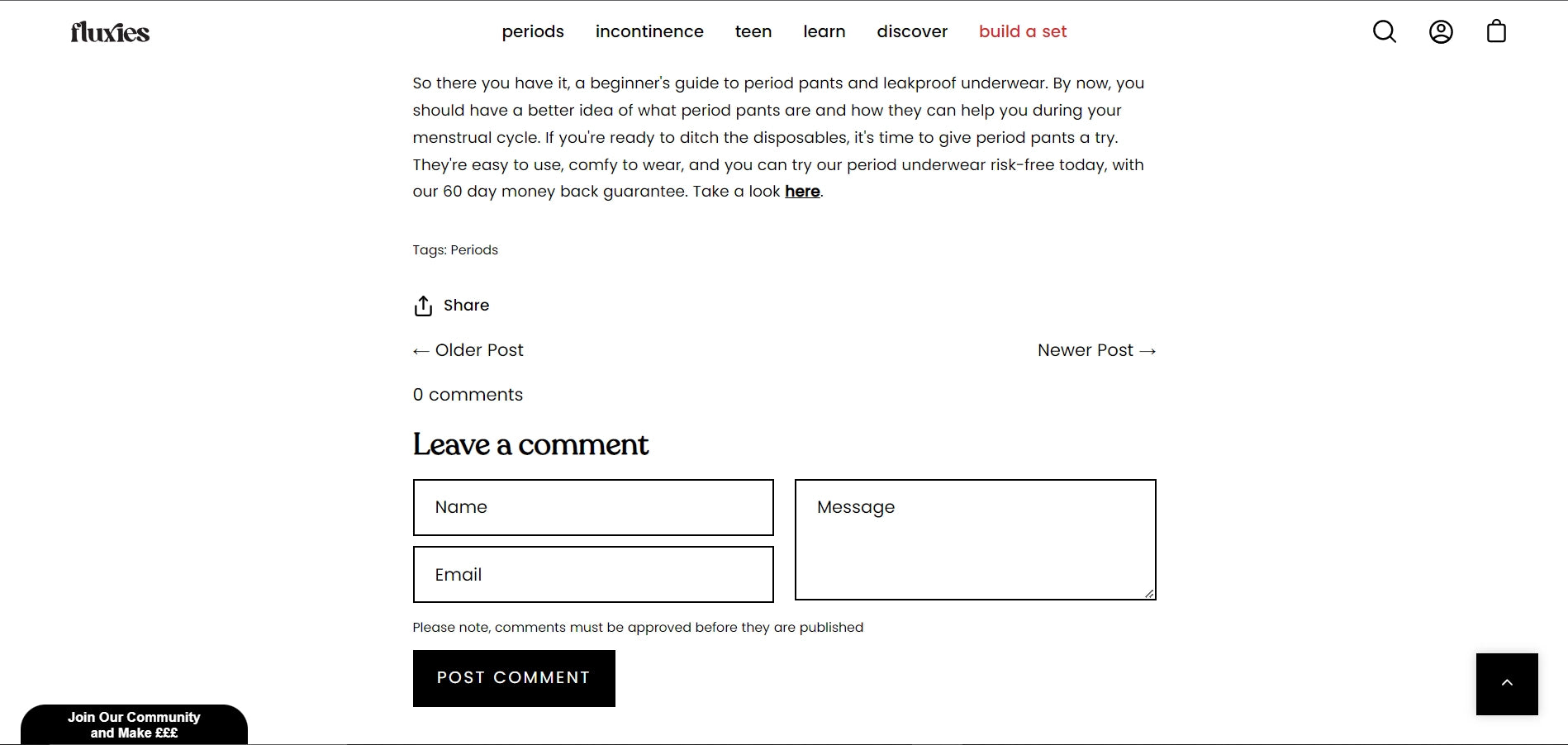
Fluxies implement a comments section on the bottom of their blog post
7. Beardbrand
Beardbrand sells men’s grooming products, and its blog is built as a reference library rather than a feed. The index splits into nine named hubs, including Beard, Mustache, Hair, Personal Growth, From the Founder, and Beardsman Profiles, each with its own landing image and browse link.

Every post carries a real human byline, and that is what sets it apart. “5 Genuine Reasons to Get a Buzz Cut in 2026”, published July 23, 2026, is credited to Mike Lawson, and the same author name is written into the page’s Person schema. Readers and AI answer engines can both see who stands behind the advice.
What’s special: Beardbrand tells you what not to buy. The buzz cut article states plainly that you do not need conditioner on a buzz cut and that styling products are pointless for one, then links to a product only where one actually helps. Losing a sale on that article is what makes the recommendation on the next one credible.
Children & Toys Shopify Blog Examples
8. Game Of Bricks
LEGO is one of the most recognized toy companies, and Game of Bricks does customized light kits based on different LEGO sets.
Their website design is simple and clear-cut, without the flashy visual content. The blog posts are mainly built around curated LEGO gift ideas, anticipated LEGO content, and in-depth review of a specific set. The vibe of their website feels like a retro game store or a digital Blockbuster, which neatly flows with the on-sale products.

Game of Bricks’ different blog topics.
What’s special: The blog posts are constantly updated, with comprehensive and helpful content, along with self-taken photos of their products. This business obviously knows their niche, and they are building a community with the same interest through the blog content.
9. Rainbow Vision
Prepare yourself for a visual buffet while on Rainbow Vision’s online store, as they offer self-designed paper goods and gifts. The artsy aura shows on their blog, now published under the name Forever Flame, which runs mindful and intimate content rather than SEO-focused posts.

Rainbow Vision’s vibrant homepage.
Learn more: Besides blog posts, it is advisable to also optimize your homepage to create a visually stunning and branded look for your online presence. Check out our guide on How to create a homepage design that captivates and converts.
The Rainbow Vision team consists of aspiring artists who are just doing what they love, and the genuineness is shown between the texts. The community, which appreciates their products, will love to have this kind of blog content in their inbox. This blogging style does not mean SEO traffic is deserted, but it is simply just a suitable approach in regard to the business’s mission.

Rainbow Vision’s personalized blog posts.
What’s special: They do not have a copious collection of blog posts, but each one is personally crafted with the artists’ own thoughts and perspectives. Instead of providing readers with the traditional type of blog posts, Rainbow Vision tells stories and gives visitors the feeling of reading through a journal.
This makes the brand personality naturally shine through without sacrificing their style for traffic or profit. Their most recent post is the founder explaining that she closed the business and later reopened it, which tells you this format survives a gap that a keyword-driven blog would not.
10. American Girl
American Girl offers a diverse range of products designed to inspire and educate young girls. Their collection includes a variety of dolls, each with unique stories and backgrounds, along with corresponding books that promote literacy and learning. Additionally, American Girl also provides customized dolls, allowing girls to create dolls that reflect their own appearance and interests, fostering a sense of individuality and self-expression.
The vibrant website layout gives the feeling of a product for kids, with rainbows and stars decorating the background of the pages. American Girl definitely did not go the minimal route, and maximalism looks great on them.
The American Girl blogs offer a rich collection of articles that cater to children. Topics include inspirational stories about their dolls, craft ideas, drinks, and cookie recipes by their dolls, along with listenable podcasts. The special visitors expect a coherent yet vibrant aesthetic throughout the whole website, and they did just the thing.

American Girl’s colorful selection of blog posts.
What’s special: American Girl knows exactly who their customers are. Therefore, they create websites and blog posts that match the interests of kids, where their products, dolls and toys, act as the characters living in each story. Each blog post is filled with images of their products and animations of the characters, making it easier for children to read through the page.
Home & Lifestyle Shopify Blog Examples
11. Au Lit Fine Linens
Au Lit Fine Linens sells bedding and sleep products, and its blog “Between The Sheets” merchandises them harder than anything else on this list without reading like a catalog.

Take “How To Style Plaid and Check Patterns In Every Room of Your Home”, published June 23, 2026. That single post links 11 separate products inside the body copy, from a navy plaid flannel duvet cover set to a washed linen throw and a cushion, each placed where it illustrates the styling point being made.
A companion post, “Tips For Sleeping With Your Dog In Bed (Without Ruining Your Sheets)”, answers a real search question and lands on the same product range.
What’s special: Every product link sits inside a sentence that was going to be written anyway, so nothing feels bolted on. If you sell a catalog where one purchase suggests the next, this is the pattern to copy. One gap worth noting: the posts carry no author name, which leaves value on the table in a category where taste and expertise are the whole pitch.
Learn more: Principles of Conversion Design: Tips to Improve Your Website’s Conversion Rates
Why study other blog examples?
There are three main benefits to analyzing other blogs:
-
Inspiration: Looking at what other blogs are doing can give you ideas for your own. You can get inspiration for everything from the overall design and layout to the specific format of posts, templates, and even the tone and voice.
-
Insight: Studying your competitors' blogs is a smart way to gain insight. For example, if a competitor starts a blog series but then only posts a couple of entries, it might suggest the series wasn't successful or was too difficult to maintain.
-
Industry Trends and Best Practices: Examining blogs from leaders in your field can give you valuable information about current trends, new technologies, and effective strategies. This helps you stay up-to-date and adjust your own content plan as needed.
How to Create Blog Posts with GemPages?
Now that the "Can you blog on Shopify” question is off the table, let’s take a look on how to add a blog to your Shopify store.
Blogging is a straightforward practice. All the effort should shine through the content itself. That is why GemPages has simplified the blog-creating process via the following easy steps.
Step 1: Go to Dashboard > Blog post, all your blog posts can be found here. The ones that are not originally created in GemPages will be labeled “From Shopify.”
Step 2: Click the “Add blog post” button to start a new blog post.

Step 3: Feel free to start from scratch and let your creativity flow, or simply select a pre-built template from the list of many. Whether you prefer a minimal design or a more colorful feel, our blog templates are sure to accommodate your needs.

Step 4: Add text, images, videos, or CTA buttons to the page. Once you are done, rename the page title and click the blue “Update” button to create a name for your new blog post. You may “Save" the post for later editing or “Publish" it right away.

Once you have learned the basics, pick a blog aesthetic that fits your store, or customize each blog depending on the content. The possibility is endless.

Shopify Blogging Strategies to Boost Traffic and Sales
To successfully use a Shopify blog to drive traffic and sales, you need a thoughtful strategy, not just random posts. Posting low-quality or irrelevant content will cause readers to leave and look for better information elsewhere.
Here are key strategies to make your blog a success:
1. Build topic clusters around customer questions
Build each content cluster around a real customer problem instead of a product category alone. Start with three to five core subjects that connect your expertise with the questions customers ask before and after a purchase.
Create a comprehensive guide for each subject, then support it with narrower articles that answer related questions. Link those posts to one another and point to a product page only when it provides the reader’s next logical step.
2. Match content to the buyer journey
A reader’s next step depends on how close they are to a purchase. Match each post and call to action to one of these stages:
-
Awareness: Answer broad questions and explain the problem without pushing a product.
-
Consideration: Help readers compare options through buying guides, use cases, and product education.
-
Conversion: Use tutorials, customer stories, and relevant recommendations to guide an informed reader toward a product page.
-
Retention: Publish care instructions, advanced tips, and complementary product ideas for existing customers.
This approach keeps informational posts useful while giving interested readers a clear path forward. It also prevents the same sales-focused call to action from appearing in every article.
3. Measure and refresh blog performance
Measure your Shopify blog by the actions it supports, not pageviews alone. Track the signals that connect content engagement with product discovery and sales:
-
Search visibility: Organic sessions, keyword positions, and changes in search traffic.
-
Content engagement: Engaged time, scroll depth, and visits to related articles.
-
Lead generation: Email signups and other content-specific conversions.
-
Product interest: Product-page clicks, add-to-cart events, and assisted conversions from blog sessions.
Review these signals regularly and update the post according to the problem you find. Refresh outdated information when traffic falls, improve internal links when readers stop after one article, and test a more relevant call to action when a post attracts traffic but few product clicks.
4. Offer a Unique Perspective
Your brand's voice and point of view on your industry are what make you unique. Use this to differentiate your content from everything else online. What unique insights can you offer? Why should people listen to you? Hook readers from the start to increase their dwell time (which Google likes) and keep them engaged.
5. Write for a Human Audience
While it's important to optimize for search engines, remember that your ultimate goal is to connect with human readers who could become customers. Don't let SEO checklists overshadow the need to write compelling, entertaining, and informative content in a distinct brand voice.
6. Use Engaging Visuals
Avoid overwhelming readers with large blocks of text. Break up your content with images, videos, bullet points, bolded text, and tables. Just as with a landing page, good design is crucial for guiding a reader's eye and making the content easy to consume.
7. Leverage All Distribution Channels
Don't rely solely on search engines for traffic. Social media, email newsletters, and paid advertising can be powerful sources of high-intent traffic. Content marketing is an integrated strategy, so be present on all the channels where your customers are. This will help your blog grow and improve your conversion rates.
The Bottom Line
No matter what industry you are in, blogging with Shopify is always a noteworthy marketing strategy to take into consideration. Depending on the objective of your business, the style and content of your blog posts are yours to decide.
If being on the front page of Google is where you think it’s at, feel free to have a look at the businesses with extreme SEO-focused content listed above. If you prefer to create more personalized types of Shopify blog posts to appeal to an existing customer base or a specific community, check out the other Shopify store owners that are doing similar deeds. If finding balance in both is your sweet spot, sway your boat that way.
It is also perfectly okay to figure out as you go. Entrepreneurship is not always following the same tried-and-true formula but building your own path.
While you brainstorm, GemPages Page Builder can give you a hand in creating a stunning visual to get started with your journey the right way.
FAQs about Shopify Blog Examples